Blostem × Indian Overseas Bank Partnership Launch at GFF 2026: IOB FDs Now Available on the Blostem SDK
Indian Overseas Bank fixed deposits are now live on the Blostem SDK. Fintech apps can offer IOB FDs online through one API integration. Launched at GFF 2026.
Key takeaways
- Indian Overseas Bank fixed deposits are now live on the Blostem SDK, launched at Global Fintech Fest 2026.
- Fintech, wealth and consumer apps can offer IOB FDs online through one API integration.
- Platforms already on the SDK can switch IOB on through configuration, with no new build.
- IOB deposits carry the same DICGC cover as any bank deposit: up to Rs 5 lakh per depositor per bank.
IOB Digital Fixed Deposits: What Went Live at GFF 2026
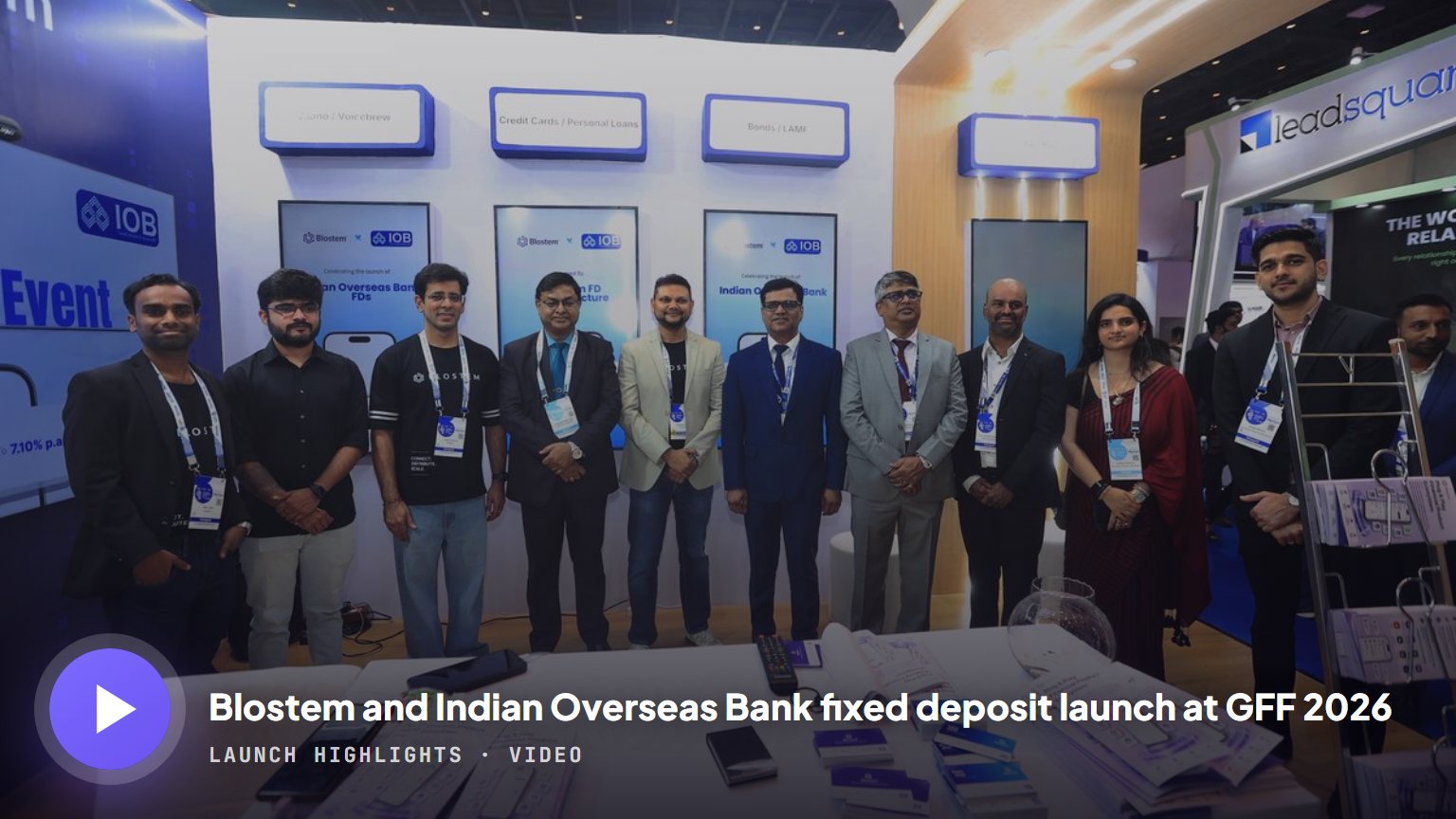
Launch highlights from Global Fintech Fest 2026: the partnership unveiling, leadership addresses and the plan to take IOB deposits to digital channels. Opens on LinkedIn.
Indian Overseas Bank joins Blostem's issuer network as a public sector bank, adding one of the country's long-established lenders alongside the private sector banks, small finance banks and NBFCs already on the platform. The launch was unveiled at Global Fintech Fest 2026, held at Jio World Convention Centre in Mumbai from 9 to 11 September 2026, where Blostem exhibited at Booth J18 and J20 in Pavilion Hall.
In practical terms, a depositor inside a partner application can now discover an IOB fixed deposit, complete the bank's verification requirements, fund the deposit and track it in their portfolio without leaving the partner's brand. The journey never sends the user to a separate bank website or app.
For platforms already live on the Blostem SDK, Indian Overseas Bank is available as a configuration change rather than a release. No new engineering work, no new integration, no app store cycle. IOB joins DCB Bank, which also went live on the Blostem SDK at GFF 2026.
Why Indian Overseas Bank Fixed Deposits Matter
Some depositors choose a bank for its rate. Many choose it for its name. Indian Overseas Bank has been building that name for almost nine decades.
- Founded in 1937, nationalised in 1969
- 3,494 domestic branches, as of March 2026
- Overseas presence in 4 countries: Singapore, Hong Kong, Thailand and Sri Lanka
- ₹6.79 lakh crore total business, as of March 2026
Indian Overseas Bank was founded on 10 February 1937 by M. Ct. M. Chidambaram Chettyar, starting business simultaneously in Karaikudi, Chennai and Rangoon with a focus on foreign exchange banking. It was one of the 14 major banks nationalised in 1969. (Source: Indian Overseas Bank.)
The bank added 159 branches in the year to March 2026, taking its domestic network to 3,494, of which 2,040 (58 per cent) are in rural and semi-urban areas. Its ATM and cash recycler network reached 3,651, and total customer touchpoints stood at 19,332 as on 31 March 2026. Total business grew 20.76 per cent year on year to ₹6.79 lakh crore. (Source: IOB press release, March 2026.)
What a Public Sector Bank Adds to a Digital FD Shelf
Most digital deposit marketplaces lean on small finance banks and NBFCs for the top of the rate range. That serves rate-led depositors well. It serves less well the depositor who wants a bank they already recognise, often one with a branch in their own town.
With more than half of its branches in rural and semi-urban India, IOB is that familiar name for a large share of savers outside the metros. Putting it on the same shelf as private banks, small finance banks and NBFCs lets a platform serve both kinds of depositor from one product page.
One thing public sector status does not change. Deposit insurance works the same way for every commercial bank. DICGC cover applies up to Rs 5 lakh per depositor per bank, principal and interest together, whether the bank is in the public or private sector. Ownership describes who holds the bank. It does not add a separate guarantee to the deposit, and partner platforms should present it that way.
What Is a Digital Fixed Deposit?
A digital fixed deposit is an ordinary term deposit with a bank, opened through an online journey inside an application rather than through branch paperwork. The deposit contract, the interest obligation and the deposit insurance are the same as a branch-opened deposit. Only the point of access changes.
Digital FD vs Branch FD at a Glance
| Digital FD | Branch FD | |
|---|---|---|
| How it is opened | Online journey inside a partner app | Paperwork at a bank branch |
| Who holds the money | Indian Overseas Bank | Indian Overseas Bank |
| Deposit insurance | DICGC cover up to Rs 5 lakh per depositor per bank | DICGC cover up to Rs 5 lakh per depositor per bank |
| KYC | Bank's KYC completed in the app, including video KYC where required | Bank's KYC completed at the branch |
| Interest rate and terms | Set by Indian Overseas Bank | Set by Indian Overseas Bank |
The bank holds the money
The deposit sits on the issuing bank's balance sheet as a liability to the depositor. The fintech platform provides the interface. Blostem provides the distribution and technology layer between the two. Neither the platform nor Blostem holds the depositor's funds at any point in the journey.
Deposit insurance attaches to the bank, not the app
Because the DICGC limit is per bank, a depositor holding deposits with three different banks through the same app has three separate limits rather than one shared ceiling. Every issuer added to a platform widens that headroom.
How Fintechs Can Offer IOB FDs Through the Blostem SDK
Blostem is the technology and distribution layer between partner platforms and issuers, which means a partner platform integrates once and inherits every issuer on the network. A single API integration covers the full deposit lifecycle:
- Discovery and comparison. Rates, tenures and issuer options surfaced in the partner's own interface.
- KYC and VKYC orchestration. Each issuer's verification requirements handled behind one flow.
- Payment and booking. Funding, confirmation and deposit advice generation.
- Portfolio and maturity tracking. Active and closed deposits, returns, maturity dates, renewal reminders.
- Servicing. Renewal, premature withdrawal, interest certificates and tax documents.
- Reconciliation and settlement. Operational plumbing between the platform and each bank.
The journey is fully white-label. Typography, colour, copy and feature toggles are configured per partner, so the deposit product reads as part of the partner's application. Technical detail is in the Blostem SDK documentation.
Banks and NBFCs on the Blostem FD Platform
With Indian Overseas Bank live, the Blostem network spans a public sector bank, private sector banks, small finance banks and NBFCs:
- NEW





Issuer availability depends on the partner programme and the current issuer configuration. Deposit terms, tenures and rates are set by each issuing institution.
What the IOB Launch Means for Fintech Platforms
- A recognised public sector name on your FD shelf, next to private banks, small finance banks and NBFCs.
- Reach beyond the metros, with a bank that has 58 per cent of its branches in rural and semi-urban India.
- Deeper DICGC headroom per depositor, since the limit applies per bank.
- No engineering cost for platforms already on the SDK, and under seven days to go live for new integrations.
Teams comparing providers may find our fixed deposit provider comparison and build versus buy analysis useful before committing engineering time.
Frequently Asked Questions
Which banks and NBFCs offer fixed deposits through Blostem?
Blostem connects fintech platforms to fixed deposits from banks and NBFCs including Indian Overseas Bank, DCB Bank, RBL Bank, Unity Small Finance Bank, Suryoday Small Finance Bank, Utkarsh Small Finance Bank, Shivalik Small Finance Bank, Bajaj Finance, Shriram Finance and Mahindra Finance. Availability depends on the partner programme and current issuer configuration.
Are Indian Overseas Bank fixed deposits booked digitally covered by DICGC insurance?
Indian Overseas Bank is a commercial bank, and deposits with commercial banks in India are insured by the Deposit Insurance and Credit Guarantee Corporation. DICGC cover applies to eligible deposits up to Rs 5 lakh per depositor per bank, covering principal and interest together. The cover attaches to the bank holding the deposit, not to the app used to open it, and applies the same way whether the deposit is opened at a branch or digitally.
Is a fixed deposit with a public sector bank insured differently from one with a private bank?
No. DICGC cover works the same way for public sector and private sector banks: up to Rs 5 lakh per depositor per bank, principal and interest together. Public sector status describes who owns the bank. It does not add a separate guarantee on top of DICGC cover, and deposit terms are set by each bank.
Can I open an Indian Overseas Bank FD online?
Yes. Fintech, wealth and consumer apps integrated with the Blostem SDK let depositors open an Indian Overseas Bank fixed deposit online, completing the bank's KYC inside the app journey. The deposit is held by IOB in the same way as a branch-opened FD, and depositors can continue to use the bank's own branch and digital channels as well.
Do I need an existing Indian Overseas Bank account to open a fixed deposit through a partner app?
No. A depositor without a prior relationship with the bank can open a fixed deposit through a partner platform and completes the bank's KYC as part of the journey, including video KYC where the bank's process requires it. Existing customers of the bank are identified first and then taken through the verification their record requires.
How can a fintech platform offer Indian Overseas Bank fixed deposits in its app?
Platforms already integrated with the Blostem SDK can enable Indian Overseas Bank through configuration, without a new integration or an app release. Platforms that have not yet integrated complete a single API integration covering discovery, KYC, payment, booking and servicing across every issuer on the platform. Blostem publishes integration documentation and provides sandbox access.
Who holds the money in a fixed deposit opened through a fintech app?
The issuing bank holds the deposit. It sits on the bank's balance sheet as a liability to the depositor. The fintech platform provides the interface and Blostem provides the distribution and technology layer between the platform and the bank. Neither the platform nor Blostem holds the depositor's funds.