How to Add Fixed Deposits to a Payments App
The three ways to offer fixed deposits in a UPI or wallet app, the six steps from agreement to first booking, how KYC and money flow, and how the app earns.
The short answer
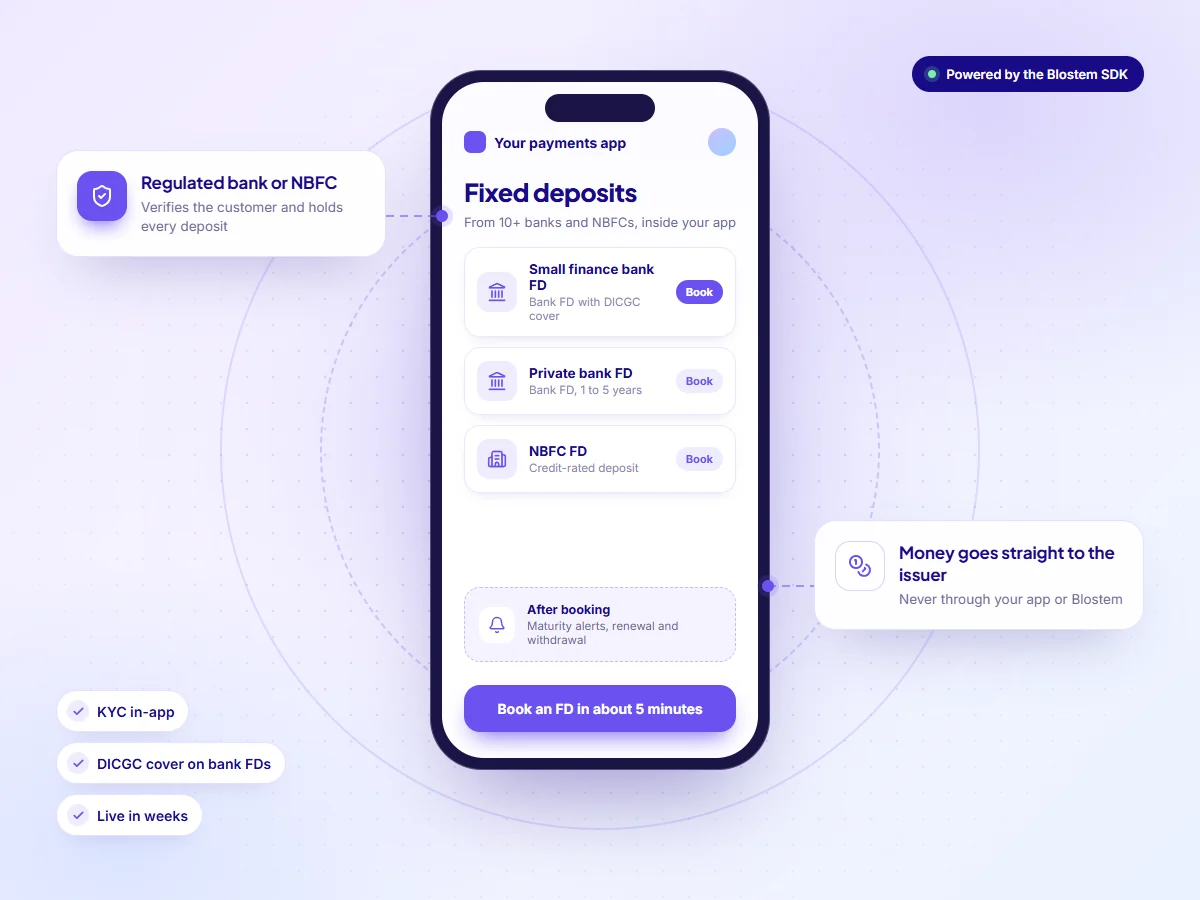
A payments app can add fixed deposits by integrating a multi-bank FD SDK from a plug-and-play embedded finance and banking infrastructure company such as Blostem. The bank or NBFC issues and holds every deposit, the customer's money goes straight to that issuer, and the app earns a share of the distribution commission without needing a banking licence.
- Your app shows FDs from several banks and NBFCs inside its own branded flow.
- The issuer runs KYC through the SDK and books the FD in the customer’s name.
- Payment goes from the customer directly to the issuer, never to the app.
- Bank FDs are covered by DICGC deposit insurance up to ₹5 lakh per depositor per bank.
- With a multi-bank SDK, an app can go live in weeks, not months.
In this guide
Why payment apps add fixed deposits
Payments bring daily usage but little revenue per user, because UPI payments carry no merchant fee. Fixed deposits turn that usage into a savings product the app can earn from, without taking any credit risk, because the issuer holds the deposit.
- Revenue per user. Every FD booked earns the app a share of the issuer’s distribution commission, on a product users already understand and trust.
- Money that stays. Users park idle balances in an FD inside the app, instead of moving them to a bank app or another platform.
- A reason to return. Maturity alerts, renewals and a portfolio view give users a reason to open the app beyond making payments.
Three ways to add fixed deposits to a payments app
In every route the bank or NBFC holds the licence and the deposit. What changes is how much your team has to build, how many issuers you can offer, and how long it takes.
| Route | Time to launch | Build cost and effort | Banks covered | Who holds the licence |
|---|---|---|---|---|
| Build in-house with each bank | Months for every bank | High: separate APIs, KYC, payments and reconciliation per bank | One per integration | The issuing bank or NBFC |
| Direct tie-up with one bank | Weeks to months | Medium: one bank’s journey, often outside your brand | One | The issuing bank |
| Multi-bank FD SDK (infrastructure provider)Recommended | Weeks | Low: one SDK, white-label journey, servicing included | 10+ with Blostem | The issuing bank or NBFC |
For most payments apps, a multi-bank FD SDK is the fastest route: one integration, many issuers, and a journey in your own brand.
Six steps from agreement to first booking
This is the path most payments apps follow with a multi-bank FD SDK.
- Choose your issuersDecide which banks and NBFCs to show. Many apps pair small finance banks, which often offer higher rates, with large NBFCs for choice.
- Sign the partnership agreementAgree which issuers you can offer and how the distribution commission is shared, before any build starts.
- Integrate the SDK in sandboxAdd the SDK to your app and run the full journey against sandbox issuers before you touch production. Read the SDK getting started guide.
- Brand the journeyApply your fonts, colours, logo and copy so every screen, from rate discovery to confirmation, looks like your app. See the SDK theming docs.
- Test end to end with each issuerRun KYC, payment, booking and confirmation with every issuer, including failed payments and video KYC, before launch.
- Launch and switch on servicingRoll out to one segment of users first, then turn on maturity alerts, auto-renewal and premature withdrawal.
How KYC and money flow work
Your app runs the experience; the issuer runs the regulated parts. KYC follows the KYC Directions, 2025, and money never passes through your app.
KYC. The customer completes PAN verification and Aadhaar eKYC inside your app, with video KYC where the issuer requires it. The issuer, not your app, is responsible for verifying the customer.
Payment. The customer pays by UPI or net banking, and the money goes straight to the issuer’s account. Neither your app nor Blostem holds customer funds.
Booking. The issuer books the FD in the customer’s name and sends the confirmation. With Blostem, the booking journey takes about 5 minutes.
Servicing. Maturity alerts, renewals and premature withdrawals run through the same SDK, so the customer never has to leave your app.
Is the deposit insured?
How a payments app earns from fixed deposits
The issuer pays a distribution commission on each FD booked, and your app earns its agreed share. Users pay nothing extra and get the issuer’s published rate. Renewals at maturity can earn again.
A simple way to size the opportunity:
Monthly FD revenue = monthly active users × % who book an FD × average FD size × your commission share
For an app with 1 lakh monthly users, run the formula with your own booking rate and average ticket size, and ask your provider for the commission on each issuer. The FD calculator shows what a deposit earns for your users.
What to check in an FD provider
Ask every provider these eight questions before you sign.
- Live issuers: How many banks and NBFCs are live today, not in the pipeline?
- Money flow: Does customer money go straight to the issuer, every time?
- Regulated partners: Is every issuer a regulated bank or NBFC?
- KYC built in: Are eKYC and video KYC part of the SDK, or extra work for you?
- White-label: Can every screen carry your brand, with no provider branding?
- Servicing: Are maturity alerts, renewal and premature withdrawal included?
- Security evidence: Can they show ISO 27001 certification and recent security audits?
- Time to launch: Can they take you live in weeks, with a sandbox to test first?
For a full scoring framework, see the FD API provider comparison checklist.
Where Blostem fits
Blostem is a plug-and-play embedded finance and banking infrastructure company in India. Its FD SDK gives a payments app one integration to 10+ banks and NBFCs, including Suryoday, Unity, Utkarsh and Shivalik Small Finance Banks, Shriram Finance, Bajaj Finance and Mahindra Finance.
The journey is white-label, booking takes about 5 minutes, and post-booking features such as maturity alerts, auto-renewal and premature withdrawal are built in. Partners typically go live in weeks. Blostem does not take deposits, lend or hold customer money.
Add fixed deposits to your payments app
Get sandbox access to the Blostem FD SDK, or see the live demo with your team.
Adding FDs to a payments app: FAQs
Frequently Asked Questions