How a Bond Platform Can Add FDs and Other Fixed Income
What SEBI rules keep separate from the OBPP, how the FD route works, how far KYC can be reused, how to build one fixed-income portfolio view, and how the platform earns.
The short answer
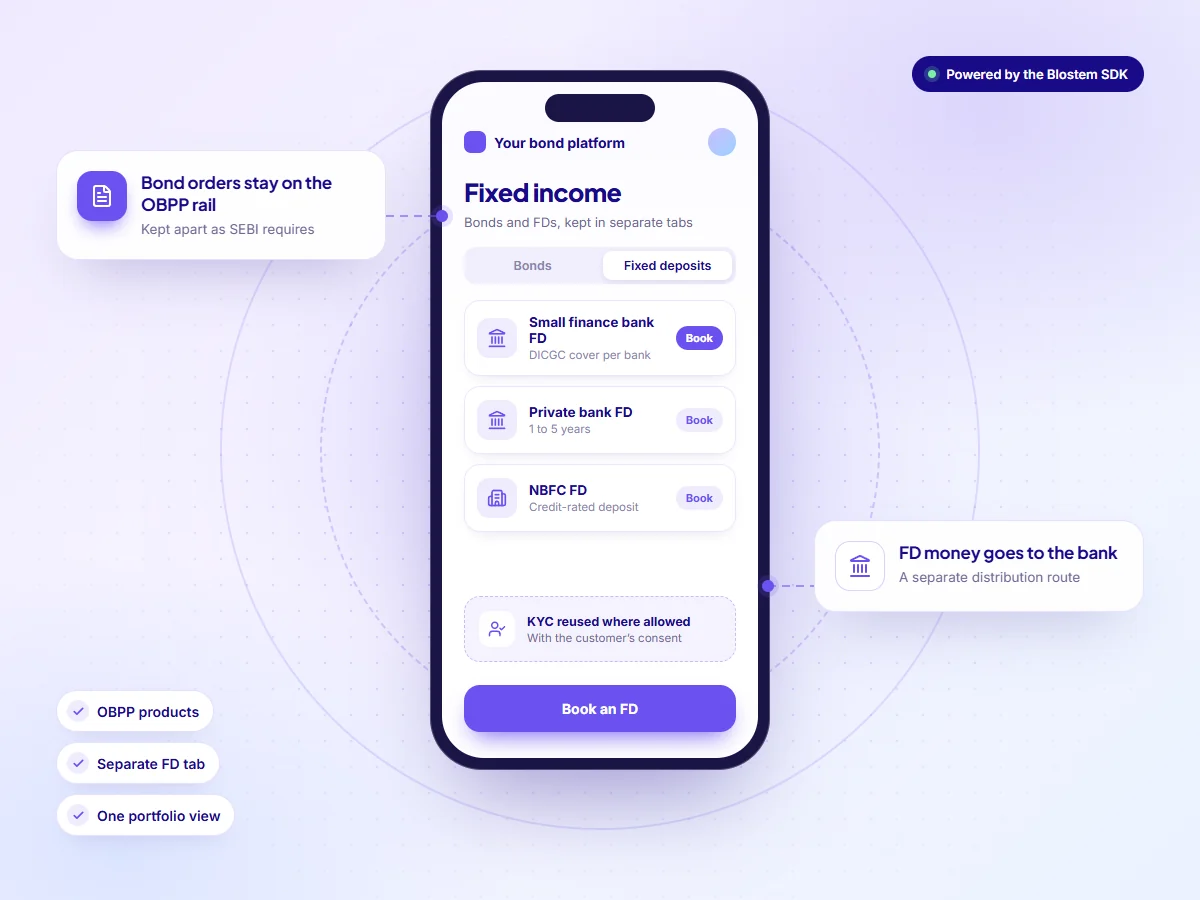
A bond platform can add FDs through a separate distribution arrangement with banks and NBFCs, shown apart from its OBPP products as SEBI requires. The fastest route is a multi-bank FD SDK from a plug-and-play embedded finance and banking infrastructure company such as Blostem. The bank or NBFC issues each FD, the money goes straight to that issuer, and the platform shows FDs in their own tab.
- SEBI lets an OBPP offer products regulated by other financial regulators, under a different tab or on a separate website.
- Bonds stay on the OBPP rail. FDs are booked by the bank or NBFC, with money paid straight to the issuer.
- With consent, existing customer details can prefill the FD journey, but the issuer runs its own KYC.
- One portfolio view can show bonds and FDs, with every holding clearly labelled.
- With a multi-bank FD SDK, the FD shelf can go live in weeks.
In this guide
Why bond platforms add FDs
Bond investors already think in yields, tenures and ratings, so FDs are a natural next shelf. They suit investors who want a fixed rate, a smaller ticket or deposit insurance, and they give coupons and maturity proceeds a place to go.
- A wider shelf. Bank, small finance bank and NBFC deposits sit beside bonds.
- Money that stays. Maturing investments can be reinvested on the platform.
- A second revenue line. FD commission adds to bond income.
What must stay separate under SEBI rules
SEBI lists what an OBPP may offer on its platform in Chapter XXI of its NCS Master Circular, most recently changed by its August 2026 circular on OBPPs. The list covers listed debt securities, debt securities in a public issue, government securities, sovereign gold bonds, 54EC bonds and products regulated by another financial sector regulator.
Bank FDs and NBFC deposits are regulated by the banking regulator, so they fall in that last group. For those products, the circular says:
- They may be offered under a different tab on the bond platform, or on another website or platform.
- They are governed by the rules of their own regulator, not SEBI’s bond rules.
- The OBPP must state the grievance redressal mechanism for them on its platform.
Three ways a bond platform can add FDs
| Route | Time to launch | Build cost and effort | Issuers covered | Who holds the licence |
|---|---|---|---|---|
| Build in-house with each issuer | Months for every issuer | High: separate integration, KYC, payments and servicing per issuer | One per integration | The issuing bank or NBFC |
| Direct tie-up with one bank | Weeks to months | Medium: one bank’s journey, often a redirect out of your app | One | The issuing bank |
| Multi-bank FD SDK (infrastructure provider)Recommended | Weeks | Low: one SDK, white-label FD tab, servicing included | 10+ with Blostem | The issuing bank or NBFC |
Six steps to add FDs to a bond platform
This is the usual path for an OBPP or bond distributor adding FDs through an infrastructure provider.
- Confirm the structure with complianceDecide whether FDs sit in a separate tab or on a separate site, which entity signs the distribution agreement, and how complaints are routed.
- Choose your issuersPick banks, small finance banks and NBFCs that suit your investors’ ticket sizes, tenures and risk appetite.
- Sign the FD distribution agreementAgree the issuers and the commission share under an arrangement kept separate from your OBPP role.
- Integrate the FD SDK in sandboxAdd the SDK and run the full FD journey against sandbox issuers, apart from your bond order flow. Read the SDK getting started guide.
- Build the separate FD tabAdd issuer names, bank or NBFC labels, DICGC status, terms and the grievance route for FDs.
- Launch and add the portfolio viewRoll out to existing bond investors first, then bring FD holdings into a clearly labelled portfolio view.
How the FD route works
The FD shelf runs on its own rail. The platform signs a distribution arrangement with the issuers, usually through the infrastructure provider, separate from its OBPP role. The issuer runs KYC, receives the money and books the FD in the investor’s name.
Bonds keep settling to the investor’s demat account, and FD money never passes through the OBPP’s accounts. The separation is real in the plumbing, not just on screen.
Reusing KYC where permitted
A bond investor has already completed KYC for the securities market. The issuing bank or NBFC is still responsible for verifying the customer under the banking regulator’s KYC rules, so the FD journey runs the issuer’s own checks. Two things can save the investor time:
- Consented prefill. With the investor’s consent, the platform can pass details it already holds, such as name, PAN, mobile number and bank account, to prefill the FD form.
- Central KYC records. The KYC Directions for commercial banks let a bank download a customer’s record from the Central KYC Records Registry with the customer’s explicit consent. Whether an issuer uses this depends on its own process.
Share customer data with an issuer only with consent, and keep a consent record for each issuer.
One fixed-income portfolio view
Investors want all their fixed income in one place. A combined view can show it while every transaction stays in its own tab.
- Group bonds and FDs separately, each labelled with the product type, the issuer and its regulator.
- Show yield to maturity for bonds and the interest rate for FDs, without blending them into one figure.
- Show DICGC cover only for bank FDs, and credit ratings for bonds and NBFC deposits.
- Add a maturity calendar across both, so investors can plan reinvestment.
How a bond platform earns from FDs
Bonds and FDs earn in different ways, so track them separately. The issuer pays a distribution commission on each FD booked, and the platform earns its agreed share. The investor pays nothing extra and gets the issuer’s published rate.
Fixed-income revenue = bond income + (FDs booked × average FD size × your FD commission share)
FD commission differs by issuer and tenure, and renewals at maturity can earn again. Coupons and bond maturities that move into FDs on the platform add revenue without the cost of finding a new customer.
What to check in an FD provider
- Separate rail: Can the FD journey run in its own tab, with its own disclosures and grievance route?
- Regulated issuers: Is every issuer a regulated bank or a deposit-taking NBFC?
- Money flow: Does investor money go straight to the issuer, every time?
- Consented prefill: Can existing customer data prefill the FD journey, with consent logged?
- Portfolio data: Can FD holdings, rates and maturity dates feed your portfolio view?
- Security evidence: Can they show ISO 27001 certification and recent security audits?
- Time to launch: Can they take you live in weeks, with a sandbox to test first?
Where Blostem fits
Blostem is a plug-and-play embedded finance and banking infrastructure company in India. Its FD SDK gives a bond platform one integration to 10+ banks and NBFCs, including Suryoday, Unity, Utkarsh and Shivalik Small Finance Banks, Shriram Finance, Bajaj Finance and Mahindra Finance, in a white-label journey that can sit in its own tab.
The RD SDK adds monthly recurring deposits with UPI Autopay for smaller tickets. Each product is easy to integrate with the Blostem SDK, and partners go live in weeks. Bond distributors that are not OBPPs can also use the Bond SDK, where a SEBI-registered OBPP executes every order.
Blostem is not the issuer, the bank or the OBPP. Banks and NBFCs hold every deposit, and Blostem does not hold customer money.
Add FDs to your bond platform
Get sandbox access to the Blostem FD SDK, or see the live demo with your product and compliance teams.
Adding FDs to a bond platform: FAQs
Frequently Asked Questions