How a Broking App Can Add Bonds and Fixed Income, and Keep Idle Cash
Why idle cash leaves broking apps, the fixed income products a broker can add, the OBPP route for bonds, the FD route, settlement to the client’s own demat, and what each product earns.
The short answer
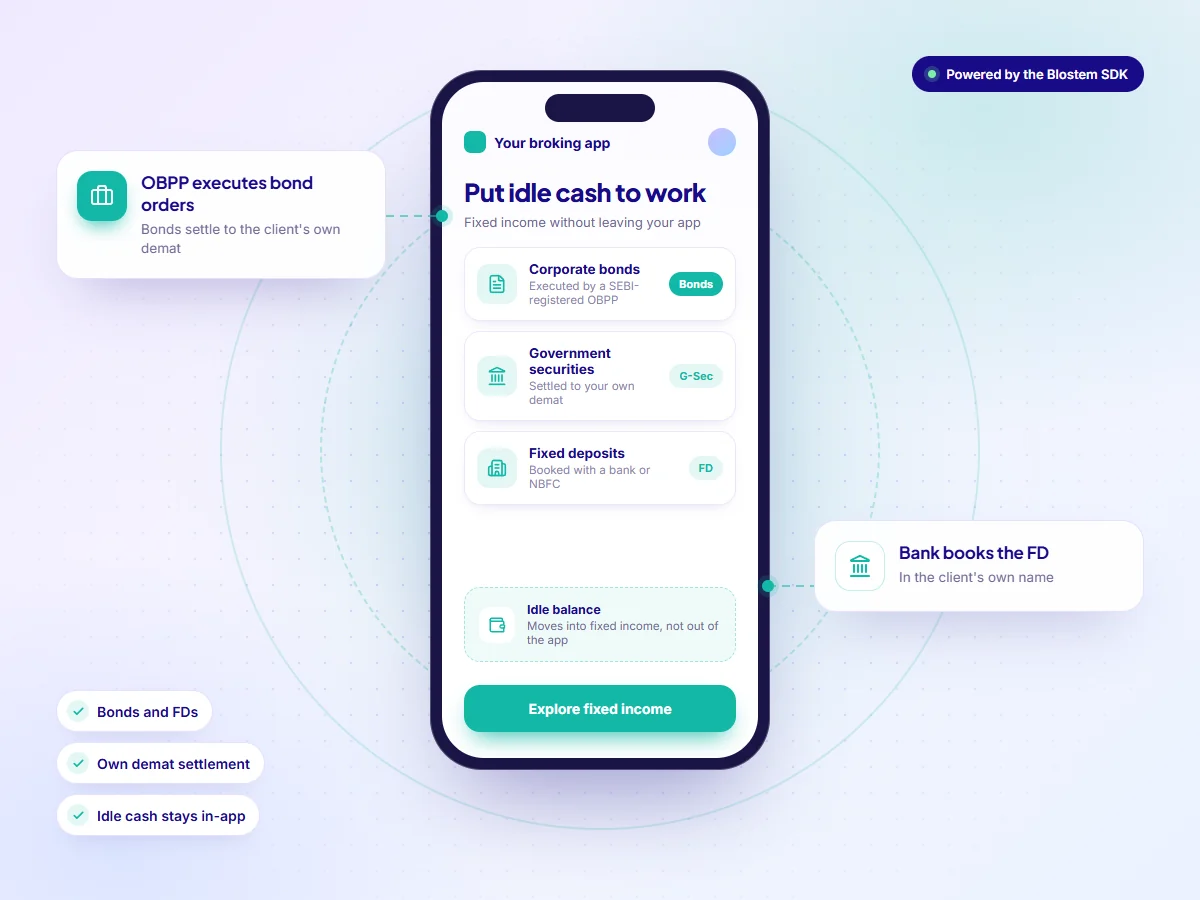
A broking app can add bonds by partnering with a SEBI-registered Online Bond Platform Provider (OBPP), and fixed deposits by partnering with regulated banks and NBFCs, through a plug-and-play embedded finance and banking infrastructure company such as Blostem. Idle cash then moves into fixed income inside the app instead of leaving it, with bonds settled to the client’s own demat account and FD money paid straight to the issuer.
- A SEBI-registered OBPP executes every bond order on NSE or BSE.
- Bonds settle to the client’s own demat account, never a pooled one.
- Banks and NBFCs issue and hold each FD; the client pays the issuer directly.
- The broker keeps the client, the brand and the full portfolio view in one app.
- Each product is easy to integrate with the Blostem SDK and can go live in weeks.
In this guide
The idle-cash problem in broking apps
Clients sell shares, receive dividends or wait between trades. That money often sits unused, or moves to a bank account and gets invested elsewhere. Either way, the broker earns nothing on it.
- Money that stays. Bonds and FDs give cash a home without leaving your app.
- Revenue from quieter clients. Clients who rarely trade can still hold fixed income.
- One portfolio view. Shares, bonds and deposits sit on one screen.
Fixed income products a broker can add
- Bonds. Corporate bonds and NCDs, government securities, tax-free bonds and 54EC capital gains bonds. With Blostem, the minimum is ₹10,000 per lot.
- Fixed deposits. FDs from banks, small finance banks and NBFCs, at a fixed rate.
- Recurring deposits. From ₹500 a month, for 6 months to 10 years, collected through UPI Autopay.
- Loan against mutual funds. Clients pledge fund units for a credit line from a regulated NBFC instead of redeeming them.
Three ways to add bonds and FDs to a broking app
In every route, an OBPP handles bond orders and a bank or NBFC issues each FD. What changes is effort, coverage and time.
| Route | Time to launch | Cost and effort | Coverage | Who holds the licence |
|---|---|---|---|---|
| Build in-house (register as an OBPP, integrate each bank) | Months for the OBPP set-up and for every bank | High: registration, compliance, settlement, reconciliation and a permanent product team | Whatever you build and maintain | You, as the OBPP, for bonds; each bank or NBFC for FDs |
| Direct tie-up with one OBPP or one bank | Months for each partner | Medium: a separate integration, KYC flow and reconciliation per partner | One partner per product | The partner OBPP for bonds; the bank for FDs |
| Infrastructure providerRecommended | Weeks | Low: SDK, white-label journeys and servicing included | Bonds through an OBPP; FDs from 10+ banks and NBFCs with Blostem | The partner OBPP for bonds; each bank or NBFC for FDs |
Six steps to launch fixed income in a broking app
This is the path most brokers follow with an infrastructure provider.
- Measure your idle cashLook at ledger balances that sit unused after a sale, a dividend or a payout, and at how long they stay there before clients withdraw them.
- Choose the route for bondsDecide whether to register as an OBPP yourself or partner with a SEBI-registered OBPP. Partnering means you do not run the OBPP role or its compliance.
- Set your catalogue rulesPick the bond types, credit rating floor and minimum ticket you will show, and the banks and NBFCs you will offer for FDs.
- Integrate the SDK in sandboxHand clients in already signed in, prefill contact, bank and demat details, and place sandbox orders against live instrument data. Read the SDK getting started guide.
- Brand the journey and sign off disclosuresApply your theme to every screen, then agree risk disclosures and disclaimers with your legal team before launch. See the SDK theming docs.
- Test, then launch to one segmentRun KYC, order, settlement and sell-request dry runs, then release to one group of clients before everyone.
How bonds and FDs flow, and who is responsible
Bonds. Selling bonds online to retail investors is covered by SEBI’s framework for Online Bond Platform Providers. OBPPs are registered with SEBI as stock brokers in the debt segment of an exchange, so a broker can register as an OBPP itself or partner with one.
Settlement. With Blostem, a SEBI-registered OBPP executes each order on NSE or BSE, and units reach the client’s own demat account with CDSL or NSDL one working day after the trade.
Fixed deposits. The bank or NBFC runs KYC through the SDK and books the FD in the client’s name. The client pays by UPI or net banking straight to the issuer.
Blostem’s role. Blostem runs the interface, KYC flow, order routing and status updates. It is not the broker, OBPP or bank.
Showing FDs next to bonds
What a broker earns from fixed income
- Bonds. Clients pay no brokerage or platform fee on Blostem bond orders, so the yield shown is the yield earned. Partner economics sit in the spread, on a basis-point plus flat-fee structure.
- FDs and RDs. The issuer pays a distribution commission on each booking, and the broker earns its agreed share. Renewals at maturity can earn again.
- Loan against mutual funds. The lender pays any sourcing fee. Under the digital lending rules for NBFCs, fees due to a sourcing partner are paid by the lender, not charged to the borrower.
A simple way to size the opportunity for each product:
Monthly revenue = clients with idle cash × % who invest × average ticket × your share per product
A sensible rollout order: bonds for clients who already think in yields, FDs for cautious savers, then RDs and loans against mutual funds.
What to check in a fixed income provider
Ask every provider these eight questions before you sign.
- Licensed partners: Is every bond order executed by a SEBI-registered OBPP, and is every FD issuer a regulated bank or NBFC?
- Own demat: Do bonds settle to the client’s own demat account, never a pooled one?
- Money flow: Does payment go to the OBPP or the issuer, never to the provider?
- Catalogue control: Can you filter what clients see by credit rating, instrument type and minimum ticket?
- Exit route: Can clients raise a sell request before maturity inside your app?
- KYC in the app: Is KYC completed in one sitting in your app, and is it portable through the KRA?
- Client cost: What, if anything, does the client pay in brokerage or platform fees?
- Time to launch: Can they take you live in weeks, with a sandbox to test first?
Where Blostem fits
Blostem is a plug-and-play embedded finance and banking infrastructure company in India. Its Bonds SDK gives a broking app a white-label bond shelf, with every order executed by a SEBI-registered OBPP and settled to the client’s own demat account.
The FD SDK adds one integration to 10+ banks and NBFCs, and recurring deposits and loan against mutual funds are each easy to integrate with the Blostem SDK. Partners typically go live in weeks. Blostem does not take deposits, lend or hold client funds or securities.
Add bonds and FDs to your broking app
Get sandbox access to the Blostem Bonds SDK, or see the live demo with your team.
Fixed income for broking apps: FAQs
Frequently Asked Questions