How Fintechs Offer FDs from Many Banks Without a Banking Licence
Who holds the licence, the three roles in the model, how money and KYC flow, what the app may say, DICGC limits per bank, and how small finance banks work with platforms.
The short answer
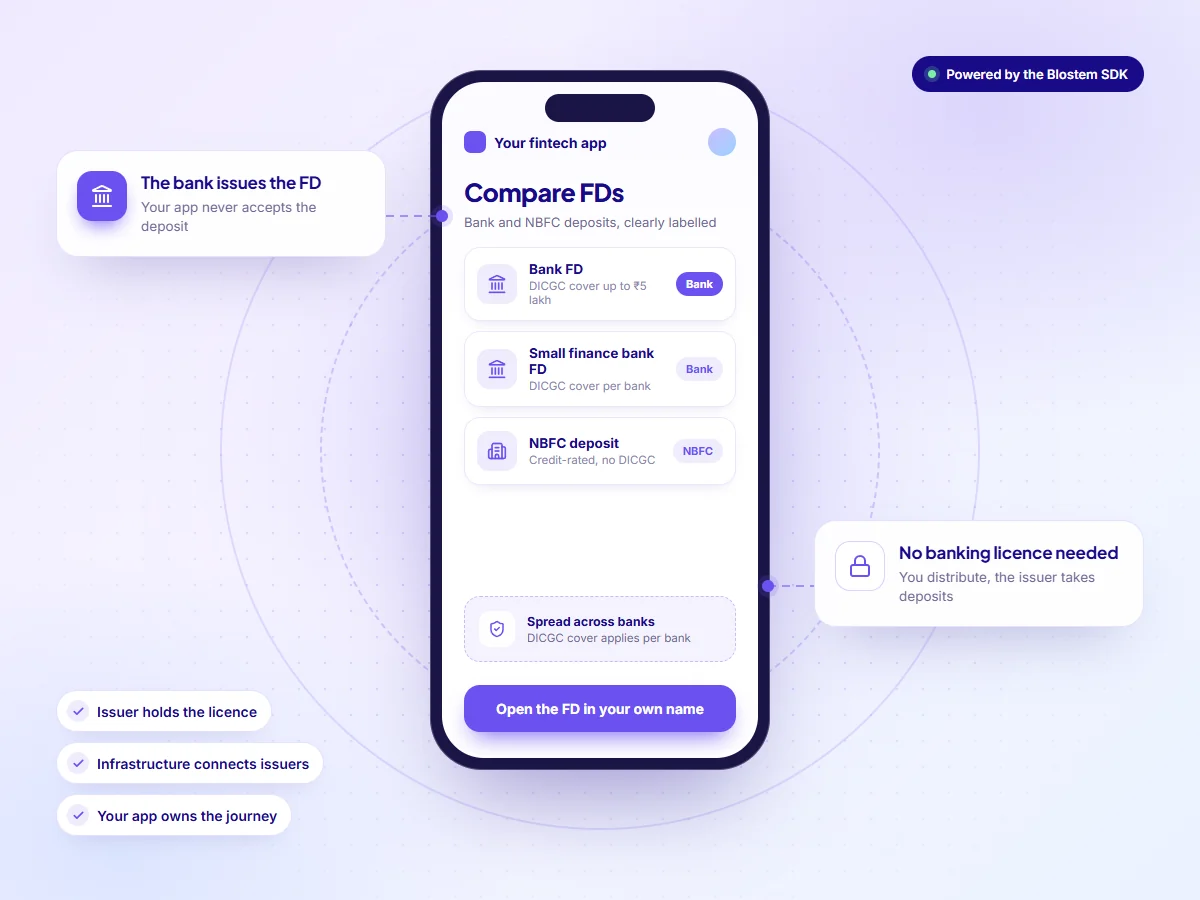
A fintech offers FDs from many banks without a banking licence by never taking the deposit itself. It partners with regulated banks, small finance banks and NBFCs through a plug-and-play embedded finance and banking infrastructure company such as Blostem. The app shows each issuer's FD, the customer pays the issuer directly, and the issuer books the FD in the customer's name.
- The bank or NBFC is the regulated entity. It takes the deposit, runs KYC and holds the money.
- The infrastructure provider connects the app to many issuers through one SDK.
- The app runs a branded journey and earns a share of the issuer’s distribution commission.
- Bank FDs carry DICGC cover up to ₹5 lakh per depositor per bank. NBFC deposits do not.
- With a multi-bank FD SDK, a fintech can go live in weeks.
In this guide
- Who is the regulated entity?
- The three roles
- Three ways to offer FDs from many banks
- Six steps to launch multi-bank FDs
- How money and KYC flow
- What the app may and may not say
- DICGC cover per bank
- Bank FDs vs NBFC deposits
- How small finance banks work with platforms
- How the fintech earns
- What to check in a provider
- Where Blostem fits
- FAQs
Who is the regulated entity?
The regulated entity is always the issuer: a bank, a small finance bank or a deposit-taking NBFC. It accepts the deposit, verifies the customer, sets the rate and repays the money at maturity. The fintech app is a distribution channel. It never accepts the deposit and never holds the customer’s money, even for a moment.
That is what lets a fintech offer FDs without a banking licence: the licence and the money sit with the issuer.
The three roles in multi-bank FD distribution
- Issuer. A bank, small finance bank or NBFC. It holds the licence and the deposit, and pays interest and maturity proceeds.
- Infrastructure provider. Runs the booking, KYC and servicing journeys across issuers. It does not hold customer money.
- Distribution app. Owns the customer and the brand, and earns a share of the issuer’s commission.
Three ways to offer FDs from many banks
| Route | Time to launch | Build cost and effort | Issuers covered | Who holds the licence |
|---|---|---|---|---|
| Build in-house with each issuer | Months for every issuer | High: separate integration, KYC, payments and reconciliation per issuer | One per integration | The issuing bank or NBFC |
| Direct tie-up with one bank | Weeks to months | Medium: one bank’s journey, often outside your brand | One | The issuing bank |
| Multi-bank FD SDK (infrastructure provider)Recommended | Weeks | Low: one SDK, white-label journey, servicing included | 10+ with Blostem | The issuing bank or NBFC |
Six steps to launch multi-bank FDs
This is the usual path for a fintech or neobank working through an infrastructure provider.
- Choose your issuer mixDecide which banks, small finance banks and NBFCs to show. A mix gives customers choice of rate, tenure and risk.
- Sign the partnership agreementsAgree the issuers, the commission share, and who handles customer queries and complaints, before any build starts.
- Integrate the SDK in sandboxAdd the SDK to your app and run the full journey against sandbox issuers before you touch production. Read the SDK getting started guide.
- Set up your disclosuresShow the issuer’s name, rate, tenure, bank or NBFC label, DICGC status and withdrawal terms on every FD screen.
- Pass each issuer’s reviewComplete the security and compliance review for each issuer, then test KYC, payment and booking end to end.
- Launch and keep it currentRoll out to one segment first, keep rates up to date, and track complaints and drop-offs by issuer.
How money and KYC flow
Money. The customer pays by UPI or net banking from their own bank account, and the money lands in the issuer’s account. Interest and maturity proceeds go back to the customer’s verified bank account.
KYC. The issuer is responsible for KYC under the banking regulator’s directions for its type of entity, such as the KYC Directions for commercial banks. The SDK collects PAN, Aadhaar eKYC and, where the issuer needs it, video KYC inside the app, then passes the result to the issuer.
Record. The FD is booked in the customer’s name with the issuer, which sends the confirmation.
What the app may and may not say
The app is presenting another company’s regulated product, so every screen must be accurate and complete. Issuers check this in their review.
- Show the issuer’s full name on every FD card, next to its current rate and tenure.
- Label each product as a bank FD or an NBFC deposit, and show the credit rating for NBFC deposits.
- Show DICGC cover only for bank FDs, and state that NBFC deposits are not insured.
- Show premature withdrawal rules, penalties and TDS before the customer pays.
DICGC cover is per depositor, per bank
Cover adds up across all of a customer’s deposits with the same bank, including savings accounts, so the app should not promise cover for any single FD.
Bank FDs vs NBFC deposits
| Point | Bank or small finance bank FD | NBFC deposit |
|---|---|---|
| Who can offer it | Any bank | Only NBFCs licensed to accept public deposits |
| DICGC cover | Up to ₹5 lakh per depositor per bank | None |
| Tenure | Set by each bank | 12 to 60 months |
| Credit rating to take deposits | Not a condition | Minimum investment grade required |
Source: the NBFC FAQs from the banking regulator. For NBFC deposits, the credit rating is the main signal of risk, so show it clearly.
How small finance banks work with platforms
Small finance banks are full banks for deposits. Their FDs carry the same DICGC cover as any other bank, and they often offer higher rates than large banks to grow their deposits. Many have smaller branch networks, so digital platforms help them reach depositors across India.
For a neobank, a small finance bank is a common first issuer. The bank sets the rate, runs KYC and books the FD, while the neobank owns the experience. Through an infrastructure provider, it can add more issuers later without a new build.
How the fintech earns from FDs
The issuer pays a distribution commission on each FD booked, and the app earns its agreed share. The customer pays nothing extra and gets the issuer’s published rate.
FD revenue = FDs booked × average FD size × your commission share, plus renewals at maturity
Commission differs by issuer and tenure, so ask your provider for each issuer’s terms before you set targets. The FD calculator shows what a deposit earns for the customer.
What to check in a provider
- Regulated issuers: Is every issuer a regulated bank or a deposit-taking NBFC?
- Money flow: Does customer money go straight to the issuer, every time?
- Live issuers: How many banks and NBFCs are live today, not in the pipeline?
- Disclosure controls: Are bank and NBFC labels and DICGC display rules built in?
- KYC built in: Are eKYC and video KYC part of the SDK, or extra work for you?
- Security evidence: Can they show ISO 27001 certification and audits by CERT-In empanelled auditors?
- Time to launch: Can they take you live in weeks, with a sandbox to test first?
For a full scoring framework, see the FD API provider comparison checklist.
Where Blostem fits
Blostem is a plug-and-play embedded finance and banking infrastructure company in India. Its FD SDK gives a fintech one integration to 10+ banks and NBFCs, including Suryoday, Unity, Utkarsh and Shivalik Small Finance Banks, DCB Bank, Indian Overseas Bank, Shriram Finance, Bajaj Finance and Mahindra Finance.
Blostem is not the issuer. It does not take deposits or hold customer money; the bank or NBFC does. Blostem is ISO 27001 certified, and its systems are tested by CERT-In empanelled auditors. The journey is white-label, and partners go live in weeks.
Offer FDs from 10+ banks and NBFCs
Get sandbox access to the Blostem FD SDK, or see the live demo with your product and compliance teams.
Offering FDs without a banking licence: FAQs
Frequently Asked Questions