How to Add a Credit Card Marketplace, Including FD-Backed Cards
Marketplace or co-branded card, how soft-check eligibility and the issuer handoff work, how FD-backed secured cards use a lien, and how the app earns.
The short answer
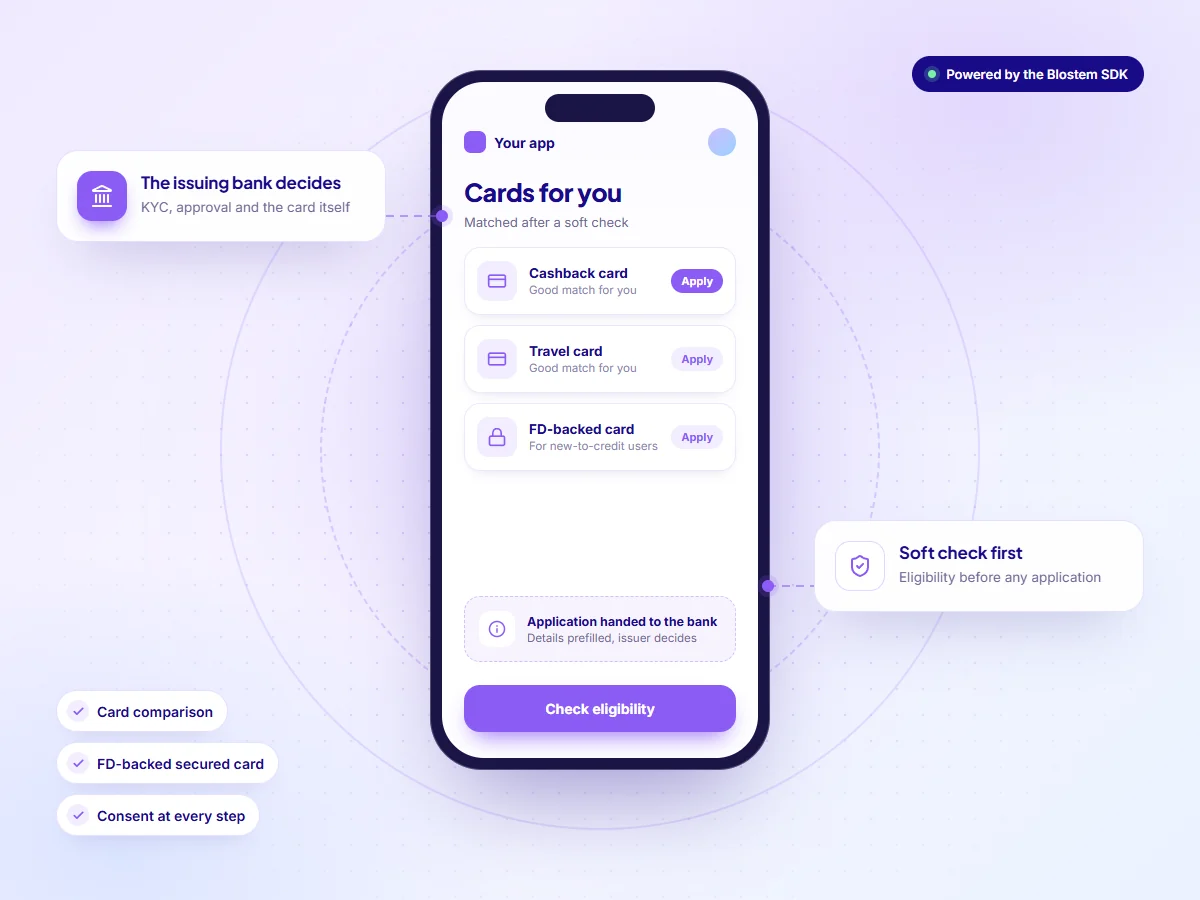
An app can add credit cards by integrating a credit card marketplace from a plug-and-play embedded finance and banking infrastructure company such as Blostem, which connects it to issuing banks. Users compare cards, check eligibility with a soft enquiry and apply, while the issuing bank does KYC, makes the decision and issues the card. Users with no credit history can be offered a secured card backed by a fixed deposit.
- The issuing bank makes every approval decision and issues every card.
- A consented soft enquiry checks eligibility without affecting the credit score.
- The application is handed to the bank with the user’s verified details prefilled, with consent.
- An FD-backed secured card gives new-to-credit users a route instead of a flat no.
- With a marketplace SDK, an app can go live in weeks.
In this guide
A marketplace or a co-branded card
There are two common ways for an app to offer credit cards. A co-branded card is one bank’s card carrying your brand, built as a joint programme. A marketplace shows cards from several issuing banks, lets users compare them and sends each application to the right bank.
A co-brand builds loyalty but ties you to one bank’s credit policy, so many users will not qualify. Under the banking regulator’s credit card directions, the co-branding partner’s role is limited to marketing and distribution, and it cannot see card transaction data. A marketplace gives every user a wider choice, and a secured card when an unsecured one is out of reach.
Three ways to add credit cards to your app
In every route, the issuing bank holds the licence, runs KYC and decides who gets a card. What changes is your build effort and user coverage.
| Route | Time to launch | Build cost and effort | Card coverage | Who holds the licence |
|---|---|---|---|---|
| Build in-house with each issuer | Months for every bank | High: a separate build per bank | One bank per integration | The issuing bank |
| Direct tie-up with one issuer | Months for a co-brand | Medium to high: a joint programme with one bank | One bank’s cards and credit policy | The issuing bank |
| Marketplace SDK (infrastructure provider)Recommended | Weeks | Low: one SDK, white-label, soft check built in | Several banks, including secured cards | Each issuing bank |
Eligibility by soft enquiry
When a user applies for a card, the bank pulls their credit report. That is a hard enquiry, and CIBIL notes that lender enquiries can affect the score, more so when there are many in a short time. Applying blind to several cards can work against a user.
A marketplace checks eligibility first with a soft enquiry, taken only after the user gives explicit consent. It does not affect the credit score. The user sees their score, the cards they match and why, and then applies once, to the card that fits. The hard enquiry happens only if they formally apply with the bank.
How the application reaches the issuing bank
When the user taps apply, they are told plainly that they are moving to the bank’s application, and their verified details arrive prefilled, with consent. The bank runs its own checks, and the status flows back to your app.
FD-backed secured cards, and how the lien works
Many first-time users have no credit history, so unsecured cards decline them. A secured card solves this. The user books a fixed deposit with the issuing bank, or pledges an existing one, and the bank marks a lien on it. The card limit is set as a share of the deposit, up to 90% of its value with Blostem.
- The FD keeps earning. The deposit stays in the user’s name and earns interest at its FD rate while it backs the card.
- Repayments build a score. The bank reports repayments to credit bureaus, so on-time payments help a thin-file user build a credit history.
- Default recovery. On persistent default, the bank recovers dues from the lien-marked deposit, as disclosed upfront.
- Closure frees the FD. When the card is closed, the lien is released and the FD is paid out on its terms.
Consent and disclosure rules
The credit card directions place the regulated duties on the card issuer. Commercial banks follow this version; small finance banks have their own. The points that shape an app’s journey:
- The issuer decides. Only the card issuer can decide to issue a card. Agents are limited to sourcing and servicing customers.
- Explicit consent. The applicant’s explicit consent is needed before a card is issued, and unsolicited cards or upgrades are banned.
- Issuer responsibility. The issuer is liable for the acts of its agents, so it will review your journey and copy.
- Key Fact Statement. A one-page Key Fact Statement goes with every application, and a rejection must come with written reasons.
How an app earns from credit cards
Issuing banks pay a payout for each card sourced through your app, usually once the card is approved and activated. Payout terms vary by bank and card type, and are agreed during onboarding. Users pay nothing extra for applying through your app.
Monthly card revenue = monthly active users × % who check eligibility × % who apply × % approved and activated × payout per card
Soft-check eligibility lifts the approval term, because users apply to cards they match. The secured route adds users who would otherwise get no card.
What to check in a credit card marketplace provider
Ask every provider these questions before you sign.
- Live issuers: Which issuing banks are live today, and which card types does each offer?
- Soft check first: Is eligibility checked with a consented soft enquiry before any application?
- Consent screen: Does the user see who checks their bureau record, and why, first?
- Clear handoff: Is the move to the bank disclosed, with verified details prefilled only with consent?
- Secured route: Can users who do not qualify for an unsecured card get an FD-backed card?
- Status tracking: Does application status come back to your app?
- Neutral ranking: Are cards ranked by fit to the user, not by payout?
- Time to launch: Can they take you live in weeks, with a sandbox to test first?
Where Blostem fits
Blostem is a plug-and-play embedded finance and banking infrastructure company in India. Its credit card marketplace SDK is live with partner banks and offers 12 card types in one catalogue, from lifetime-free to secured to premium. Eligibility runs on a consented soft check, and users see their CIBIL score free inside the flow.
Its FD-backed secured credit card route is live, with the lien on the deposit marked at issuance and released on closure. Blostem does not issue cards, lend or hold customer money. Partners typically go live in weeks, and each Blostem product is easy to integrate with the Blostem SDK.
Add a credit card marketplace to your app
Get sandbox access to the Blostem credit card SDK, or see the live demo with your team.
Adding a credit card marketplace: FAQs
Frequently Asked Questions