How to Offer Personal Loans Without an NBFC Licence
What a Lending Service Provider does, why a panel of lenders funds more borrowers than one, how money and disclosures flow, and the seven steps to go live.
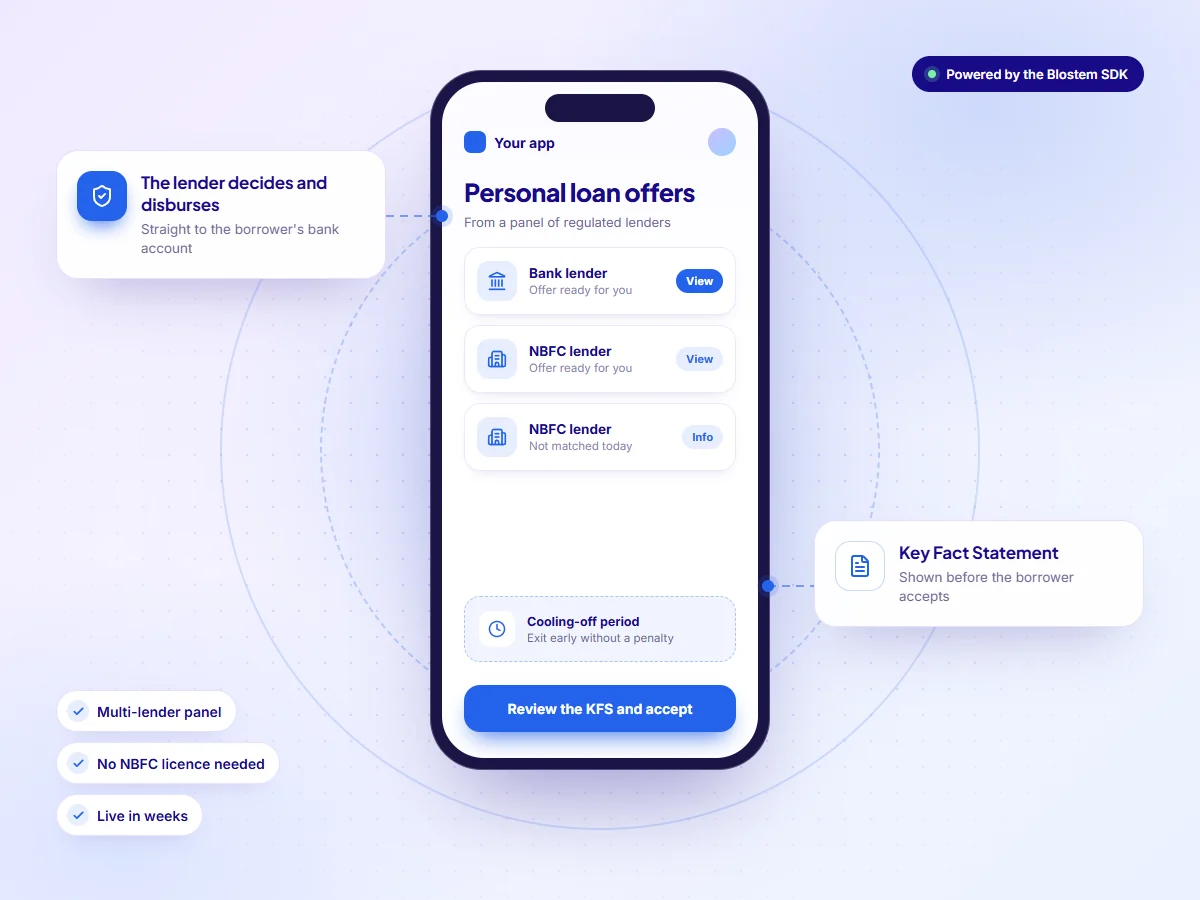
The short answer
An app can offer personal loans without an NBFC licence by working with regulated banks and NBFCs through a plug-and-play embedded finance and banking infrastructure company such as Blostem, which acts as the Lending Service Provider (LSP) layer. The lender underwrites, sanctions and disburses every loan straight to the borrower’s bank account, while your app runs the branded journey and holds no loan on its books.
- A regulated bank or NBFC is the lender and makes every credit decision.
- Loan money goes from the lender to the borrower’s bank account, and repayments go straight back to the lender.
- The borrower sees a Key Fact Statement before accepting, and can exit during a cooling-off period.
- A multi-lender panel checks one application against several lenders’ policies, so more applicants find a lender.
- With an LSP SDK, an app can go live in weeks.
In this guide
What a Lending Service Provider is
Under the banking regulator’s Digital Lending Directions, 2025, a Lending Service Provider is an agent of a regulated lender that carries out one or more of its digital lending functions. These include finding customers, underwriting and pricing support, servicing and recovery. The same rules now sit in the digital lending chapter of each lender type’s credit directions, such as the credit facilities directions for NBFCs.
The LSP never lends. A regulated bank or NBFC lends, and the LSP works on its behalf. That is why an app can offer personal loans without its own NBFC licence.
Three ways to offer personal loans in your app
In every route, a regulated lender holds the licence and the loan. What changes is your build effort, borrower coverage and time to launch.
| Route | Time to launch | Build cost and effort | Borrower coverage | Who holds the licence |
|---|---|---|---|---|
| Build in-house with each lender | Months for every lender | High: a separate build per lender | One lender’s policy per build | The lending bank or NBFC |
| Direct tie-up with one lender | Weeks to months | Medium: one lender’s journey, often outside your brand | Only applicants that one lender accepts | The lending bank or NBFC |
| Multi-lender SDK (infrastructure provider)Recommended | Weeks | Low: one SDK, white-label, disclosures built in | A panel of lenders, each on its own policy | Each lending bank or NBFC |
Getting your own NBFC licence is a fourth route, but it means capital, registration and running a credit book. Apps that only distribute loans do not need it.
One lender or a panel of lenders
Every lender has its own credit policy on income, employer type and bureau history. With one lender, every applicant outside that policy is declined, even when another lender would fund them.
A multi-lender panel checks one consented application against each lender’s own policy at the same time. Blostem states approval coverage of 70 to 90% across its panel, against 40 to 60% on any single lender. That is coverage, not a promise of approval for any one borrower.
Since 1 November 2025, an LSP working with several lenders must show all offers that match the borrower’s request, name the lenders that did not match, and stay unbiased. Each offer shows the lender, amount, tenure, APR, monthly repayment and a Key Fact Statement link.
Seven steps to go live with personal loans
This is the path most apps follow with a multi-lender LSP SDK.
- Pick where loans appear in your appChoose moments that suit your users, such as a home screen card or a section for larger purchases.
- Sign with the LSP and its lender panelAgree which regulated lenders you will show and how the lenders’ sourcing fee is shared with your app.
- Integrate the SDK in sandboxAdd the SDK, set up single sign-on with contact details prefilled, and run the journey against test lenders. Read the SDK getting started guide.
- Brand the journeyApply your fonts, colours and copy so every screen looks like your app, with no redirect. See the SDK theming docs.
- Review disclosures with each lenderCheck the consent text, Key Fact Statement, lender names and grievance contacts before launch.
- Test end to endRun consent, the soft check, offers, acceptance and disbursal status for every lender, including declines.
- Launch to one segment firstOpen the journey to a small group, then show loan status and repayments in your app.
How money flows, and the rules that protect borrowers
Direct money flow. Disbursal must go into the borrower’s own bank account, and repayment straight to the lender, with no third-party pool account.
Fees. Any fee due to an LSP is paid by the lender. It cannot be charged to or collected from the borrower.
Grievances. The lender and any LSP that deals with borrowers must each name a grievance redressal officer and publish their contact details, including in the Key Fact Statement.
Default loss guarantee. If a lender asks for first-loss cover, the rules cap it at 5% of the amount disbursed from that loan portfolio.
Who the lender is, and what Blostem does
Every lender on the panel is a regulated bank or NBFC. It sets its credit policy, makes the final decision, sets the rate and fees, disburses the loan, keeps it on its books and handles collections.
Blostem sits as the Lending Service Provider layer between your users and the panel. It runs KYC, captures consent before any bureau pull, checks the borrower against each lender’s criteria and hands the chosen application to that lender. Blostem does not lend, take deposits or hold borrower money.
Your app owns the entry point and the brand. Lenders publish their LSPs and the apps those LSPs use, so expect your app to be named in their disclosures.
How an app earns from personal loans
The lender pays a sourcing fee for each loan disbursed through the LSP, and your app earns its agreed share. The borrower pays only the lender’s own charges, shown in the Key Fact Statement.
Monthly loan revenue = monthly active users × % who apply × % funded across the panel × average loan size × your share of the sourcing fee
The “% funded” term is where a panel matters most: the same applicants, more of them funded. Ask your provider for each lender’s fee before you model it.
What to check in a personal loan provider
Ask every provider these questions before you sign.
- Regulated lenders: Is every lender a regulated bank or NBFC, and how many are live today?
- Direct money flow: Does money always go lender to borrower, and back to the lender?
- Multi-lender display: Does the offer screen show every matching lender, without bias?
- Consent first: Is consent taken before any bureau pull, with data sent only to the chosen lender?
- Disclosures built in: Are the Key Fact Statement and grievance contacts built into the SDK?
- White-label: Does the journey run in your app, with no redirect or provider branding?
- Audit trail: Can you see consents, offers and status for every application?
- Time to launch: Can they take you live in weeks, with a sandbox to test first?
Where Blostem fits
Blostem is a plug-and-play embedded finance and banking infrastructure company in India. Its personal loan SDK connects your app to a multi-lender panel of regulated banks and NBFCs, with loans from ₹50,000 to ₹25 lakh, tenures of 3 to 60 months and rates from 10% a year, set by each lender.
Users go from consent to ranked, real offers in under 10 seconds, with the Key Fact Statement one tap away. The journey is white-label, and partners typically go live in weeks. Each Blostem product is easy to integrate with the Blostem SDK.
Offer personal loans in your app
Get sandbox access to the Blostem personal loan SDK, or see the live demo with your team.
Offering personal loans without an NBFC licence: FAQs
Frequently Asked Questions