Best Cross-Sell Products for a Digital Lending App
How to match each borrower state, from rejected to repaid, to the right product, what each one earns, the consent rules that apply, and the order to launch them in.
The short answer
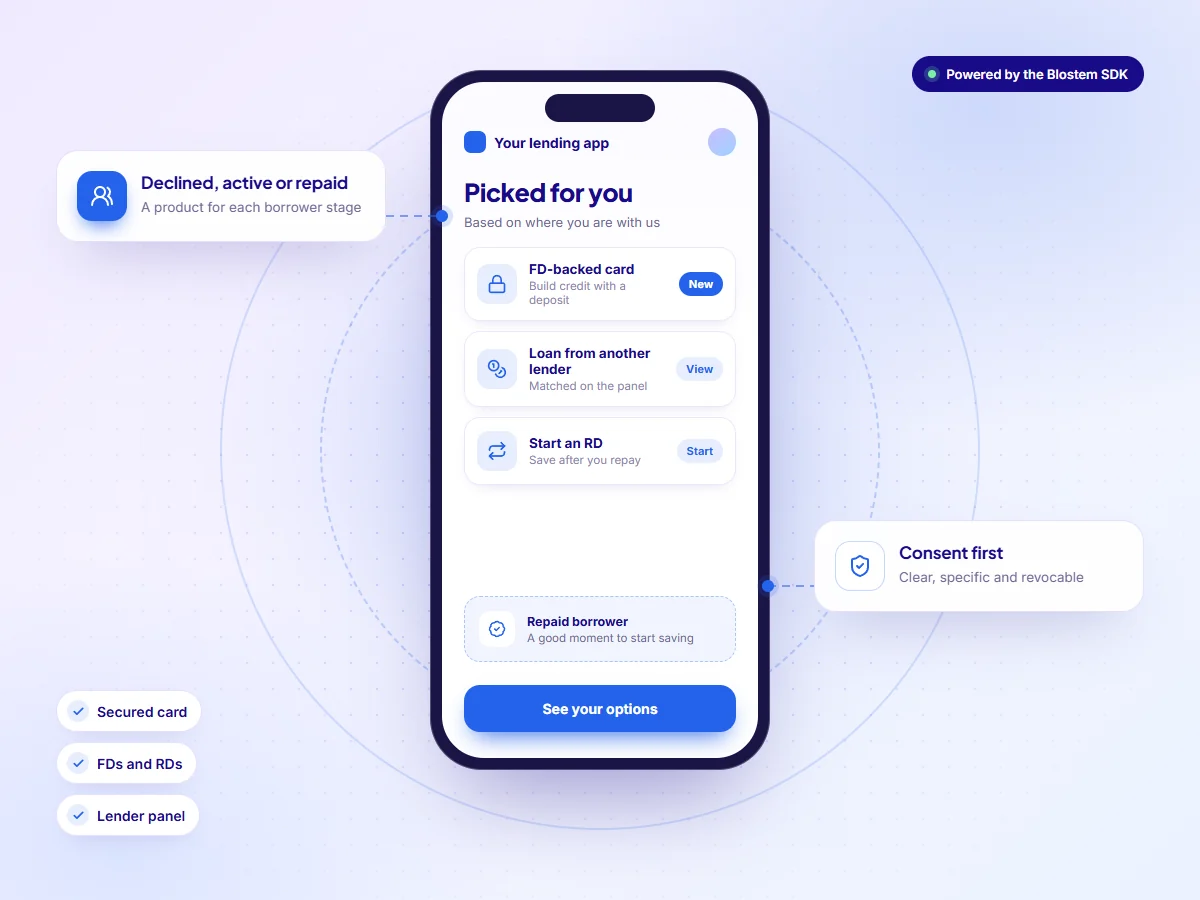
The strongest cross-sells for a digital lending app are an FD-backed secured credit card and a multi-lender marketplace for applicants its own lender declines, a credit card matched by a soft check for active borrowers, and fixed or recurring deposits for borrowers who have repaid. A lending app can add each one by partnering with regulated banks and NBFCs through a plug-and-play embedded finance and banking infrastructure company such as Blostem, with fresh consent for each offer.
- Declined applicants: a second look from a lender panel, or an FD-backed card to build a credit history.
- Active borrowers: a credit card matched by a soft eligibility check, or a loan against mutual funds.
- Repaid borrowers: an RD or FD for the money that used to go to EMIs.
- Each bank or NBFC makes its own decision; the app never promises approval.
- Each new offer needs clear consent; loan data cannot simply be reused.
In this guide
Why lending apps cross-sell
A lending app pays to bring in every applicant, but many leave after one decision: some are declined, others repay and move on. Cross-sell turns that decision into a longer relationship.
A decline usually reflects one lender’s policy, a thin credit file or a short work history, not the person. In Blostem’s figures, a single lender funds roughly 40 to 60% of applicants, while a multi-lender panel reaches 70 to 90% approval coverage.
Match each borrower state to a product
| Borrower state | What they need | Best product | Regulated partner |
|---|---|---|---|
| Declined by your lender | A second look, or a way to build a credit history | Multi-lender personal loan marketplace; FD-backed secured card | A panel of banks and NBFCs; the card-issuing bank |
| Active borrower | Fair-cost credit matched to their profile | Credit card by soft eligibility check; loan against mutual funds if they hold funds | The card-issuing bank; a regulated NBFC |
| Repaid borrower | A place for the money that went to EMIs | Recurring deposit; fixed deposit | A bank or NBFC |
Declined applicants. One consented application can be matched against several lenders’ policies at once. For applicants with little or no credit history, an FD-backed secured card offers a route to build one.
Active borrowers. A card marketplace shows matched cards after a soft check that does not affect the credit score. Users with mutual funds can borrow against them.
Repaid borrowers. A user used to paying a monthly EMI can keep the habit with an RD from ₹500 a month, or move a lump sum into an FD.
Three ways to add cross-sell products
| Route | Time to launch | Cost and effort | Coverage | Who holds the licence |
|---|---|---|---|---|
| Build in-house with each partner | Months for each lender, issuer or bank | High: separate integration, consent, KYC and reconciliation per partner | One partner per build | Each lender, card issuer or deposit issuer |
| Direct tie-up with one partner | Weeks to months | Medium: one partner’s journey and policy | One lender or issuer, so declines stay high | That partner |
| Infrastructure providerRecommended | Weeks per product | Low: SDK, white-label journeys and consent screens included | A lender panel, card issuers and 10+ FD issuers with Blostem | Each regulated partner |
Six steps to launch cross-sell in a lending app
This is the path most lending apps follow with an infrastructure provider.
- Segment borrowers by stateGroup users as declined, active or repaid, using only the data you have consent to use for that purpose.
- Match one product to each stateUse the table below to pick the first product for each group, and the regulated partner behind it.
- Choose the regulated partnersSign with a panel of lenders, the card-issuing banks and the banks and NBFCs that will issue deposits.
- Integrate the SDK in sandboxAdd each product journey to your app and test it against sandbox partners before production. Read the SDK getting started guide.
- Ask for consent on each offerExplain what data each new product uses and why, and let the user say no without affecting their loan.
- Launch in order and measureStart with the group where you lose the most users, measure take-up, then add the next product.
Who does what in each cross-sell
Lenders. A regulated bank or NBFC makes every credit decision, and the app offers its loans through a lending service provider (LSP) layer that works for that lender. Under the digital lending rules for banks and for NBFCs, the loan is paid into the borrower’s bank account, repayments go straight to the lender, and any sourcing fee is paid by the lender, not the borrower.
Card and deposit issuers. The issuing bank runs KYC and decides on each card. Banks and NBFCs book FDs and RDs in the user’s name; bank deposits are covered by DICGC up to ₹5 lakh per depositor per bank.
Blostem runs the journeys, KYC flows and consent capture. It does not lend, issue cards or take deposits.
Consent and data rules for cross-sell
Under the digital lending rules, data collected through a lending app must be need-based and taken with the borrower’s prior, explicit consent. The borrower must be able to give or deny consent for specific data, and explicit consent is needed before personal data is shared with a third party.
The Digital Personal Data Protection Act, 2023 also requires consent that is free, specific, informed and unambiguous, limited to a stated purpose, and possible to withdraw. Its rules were notified in November 2025 and are being phased in.
- Ask for consent on its own screen for each new product, and say what data it uses.
- Never make the loan depend on taking another product.
- Where you show several lenders, show every matching offer and name the lenders that did not match, as the rules require.
Revenue per product, and the order to launch
- Personal loans. The lender pays the sourcing fee. The borrower pays only the charges the lender sets, shown in the Key Fact Statement.
- Credit cards. The issuing bank pays under your agreement for cards issued through your app.
- FDs and RDs. The issuer pays a distribution commission on each booking, and your app earns its agreed share.
Cross-sell revenue = users in a state × % who take the offer × your earning per product
- Declined applicants first. A decline ends the relationship at the first step, so a lender panel and a secured card keep those users soonest.
- Repaid borrowers next. Deposits carry no credit risk and suit freed-up cash flow.
- Active borrowers last. Card offers work best once you know the user.
What to check in a provider
- Regulated partners: Is every lender, card issuer and deposit issuer a regulated bank or NBFC?
- Lender panel: How many lenders are live, and is each judged on its own policy?
- Neutral matching: Are offers ranked by fit for the borrower, not by payout?
- Consent screens: Is consent captured before any bureau pull or data sharing, with an audit trail?
- Money flow: Does money move only between the user and the regulated partner?
- Disclosures: Are Key Fact Statements and card terms shown before the user accepts?
- Product range: Can you add cards and deposits later, without a new provider?
- Time to launch: Can they take you live in weeks, with a sandbox to test first?
Where Blostem fits
Blostem is a plug-and-play embedded finance and banking infrastructure company in India. Its Personal Loans SDK matches one consented application to a multi-lender panel of regulated banks and NBFCs, for loans from ₹50,000 to ₹25 lakh, with ranked offers in under 10 seconds.
The FD-backed secured card, the credit card marketplace, fixed deposits, recurring deposits and loan against mutual funds are each easy to integrate with the Blostem SDK. Partners typically go live in weeks.
Add cross-sell products to your lending app
Get sandbox access to the Blostem SDK, or see the live demo with your team.
Cross-selling in a lending app: FAQs
Frequently Asked Questions