How to Offer Loan Against Mutual Funds on a Wealth Platform
Why a credit line beats redemption, how lien marking works at the registrar, how LTV is set, the six steps to launch, and what the platform earns.
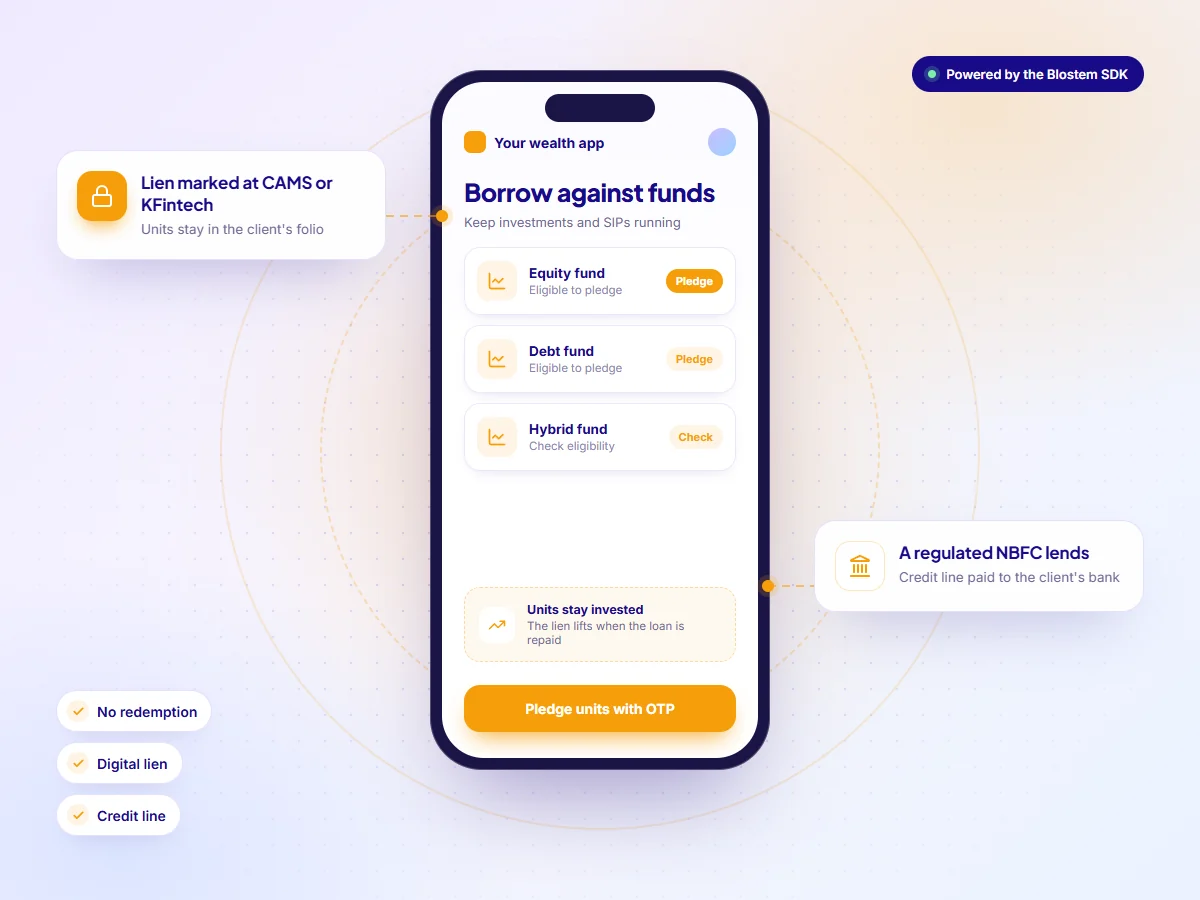
The short answer
A wealth platform can offer loan against mutual funds by partnering with a regulated NBFC lender through a plug-and-play embedded finance and banking infrastructure company such as Blostem. The client pledges units instead of redeeming them, a lien is marked digitally through CAMS, KFintech or MFCentral, and the NBFC lends against those units. The platform needs no lending licence, and the units never leave the client’s folio.
- A regulated NBFC underwrites, disburses and holds every loan.
- Units are pledged, not sold, so SIPs keep running and nothing is redeemed.
- The lien sits with the registrar and is released once the loan is repaid.
- The NBFC pays the client’s bank account directly, and repayments go straight back to it.
- With a LAMF SDK, a platform can go live in weeks.
In this guide
Why a credit line beats redemption
When a client needs cash, the usual answer is to redeem. That ends the investment, can trigger an exit load and capital gains tax, and takes assets off your platform. A loan against mutual funds lets the client raise money and stay invested.
- Stay invested. Pledged units stay in the client’s folio, SIPs keep running and market gains stay theirs.
- No sale, no tax event. Nothing is redeemed, so there is no exit load and no capital gains from selling.
- A secured rate. Backed by units, the rate is usually lower than an unsecured personal loan.
- Pay for what you use. As a revolving line, interest accrues only on the amount drawn, not the full limit.
Three ways to offer loan against mutual funds
In every route, an NBFC holds the licence and the loan. What changes is your build effort and whose journey clients see.
| Route | Time to launch | Build cost and effort | Coverage | Who holds the licence |
|---|---|---|---|---|
| Build in-house with an NBFC | Months | High: lien flows per registrar, KYC, eSign and repayments | The registrars you integrate | The NBFC lender |
| Direct tie-up with one lender’s journey | Weeks to months | Medium: the lender’s flow, often a redirect outside your brand | That lender’s fund list | The NBFC lender |
| LAMF SDK (infrastructure provider)Recommended | Weeks | Low: one SDK, white-label, lien flows built in | Folios across both registrars | The NBFC lender |
How lien marking works
Mutual fund units are recorded by two registrars, CAMS and KFintech. MFCentral is the investor services platform the two run together. A lien is a mark on the client’s units at the registrar in favour of the lender.
While the lien is in place, pledged units cannot be redeemed or switched, but they keep earning. Once the loan is closed, the lien is released.
How the limit and LTV are set
The limit is the value of the pledged units multiplied by the loan-to-value (LTV) ratio for each fund. The NBFC sets the eligible fund list and the LTV for each fund type in its credit policy. LTV is usually higher for debt funds than for equity funds, because debt fund values move less.
Credit limit = sum of (value of each pledged fund × LTV for that fund type)
Units still in a lock-in, such as ELSS, are generally not eligible. A good journey shows each fund’s LTV and why any fund is ineligible.
Credit line or term loan. Some lenders offer a term loan with EMIs. Others offer a revolving line, like an overdraft, where the client draws, repays and draws again within the limit.
Six steps to launch loan against mutual funds
This is the path most wealth platforms and MFDs follow with a LAMF SDK.
- Choose where the offer appearsShow the credit line where clients need cash, such as the redemption screen, so borrowing sits next to selling.
- Sign with the NBFC lender and providerAgree the eligible fund list, the LTV for each fund type and how the platform is paid.
- Integrate the SDK in sandboxAdd the SDK with single sign-on, then run holdings, limit, KYC, pledge and eSign against test data. Read the SDK getting started guide.
- Brand the journeyApply your fonts, colours and logo so every screen, from limit to repayment, looks like your platform. See the SDK theming docs.
- Test lien marking and releaseCheck pledges and releases for CAMS and KFintech folios, including partial pledges and early closure.
- Launch and switch on servicingOpen the line to one segment first, then turn on auto-pay for interest and repayment views.
Who lends, and the rules that apply
The lender of record is a regulated NBFC. It underwrites, sanctions, disburses and holds every loan, and sets the rate and charges. Blostem provides the technology for the limit, KYC, pledge, lien, eSign and repayment journey. It does not lend off its own book or hold client money. Your platform offers the journey to its clients and does not lend.
Because the loan is sourced and signed digitally, the banking regulator’s digital lending rules for NBFCs apply. Disbursal goes into the borrower’s own bank account, repayment goes straight to the NBFC with no pool account in between, and the client sees a Key Fact Statement before signing.
What the platform earns
LAMF earns in two ways. The NBFC pays the platform for loans sourced through it, on terms agreed during onboarding. And assets that would have been redeemed stay on the platform, so an MFD keeps earning trail commission on them.
Monthly LAMF value = clients with eligible holdings × % who open a line × average amount drawn × your agreed share + assets kept instead of redeemed
Start with your redemption data: each redemption made only to raise cash is a client who could have borrowed. Ask your provider how lender payouts work before you model it.
What to check in a LAMF provider
Ask every provider these questions before you sign.
- Regulated lender: Is the lender of record a regulated NBFC, named in every document the client signs?
- Registrar coverage: Does the lien work for folios with both CAMS and KFintech, and through MFCentral?
- Units stay put: Do the units stay in the client’s own folio, never moved to a pool or sold to fund the loan?
- Direct money flow: Does the lender pay the client’s bank account and collect repayments directly?
- Disclosures in-app: Are the Key Fact Statement and loan agreement shown and eSigned inside the flow?
- Clear LTV: Does the client see each fund’s LTV and why any fund is ineligible?
- Servicing: Are auto-pay, part-repayment, closure and lien release included?
- Time to launch: Can they take you live in weeks, with a sandbox to test first?
Where Blostem fits
Blostem is a plug-and-play embedded finance and banking infrastructure company in India. Its loan against mutual funds SDK lets a wealth platform, broker or MFD offer a credit line of up to ₹2 crore per borrower, at up to 80% of the value of eligible holdings, with indicative rates from 9.5% a year set by the NBFC lender.
Clients see a limit worked out from live holdings, with no bureau pull just to check eligibility, and go from PAN to an active line in minutes. The journey is white-label, and partners typically go live in weeks. Each Blostem product is easy to integrate with the Blostem SDK.
Offer loan against mutual funds on your platform
Get sandbox access to the Blostem LAMF SDK, or see the live demo with your team.
Loan against mutual funds for wealth platforms: FAQs
Frequently Asked Questions