What a Neobank Can Launch in India Without Its Own Licence
Which products a neobank can offer without a banking or NBFC licence, who holds each licence, how long each takes to launch, and which one earns first.
The short answer
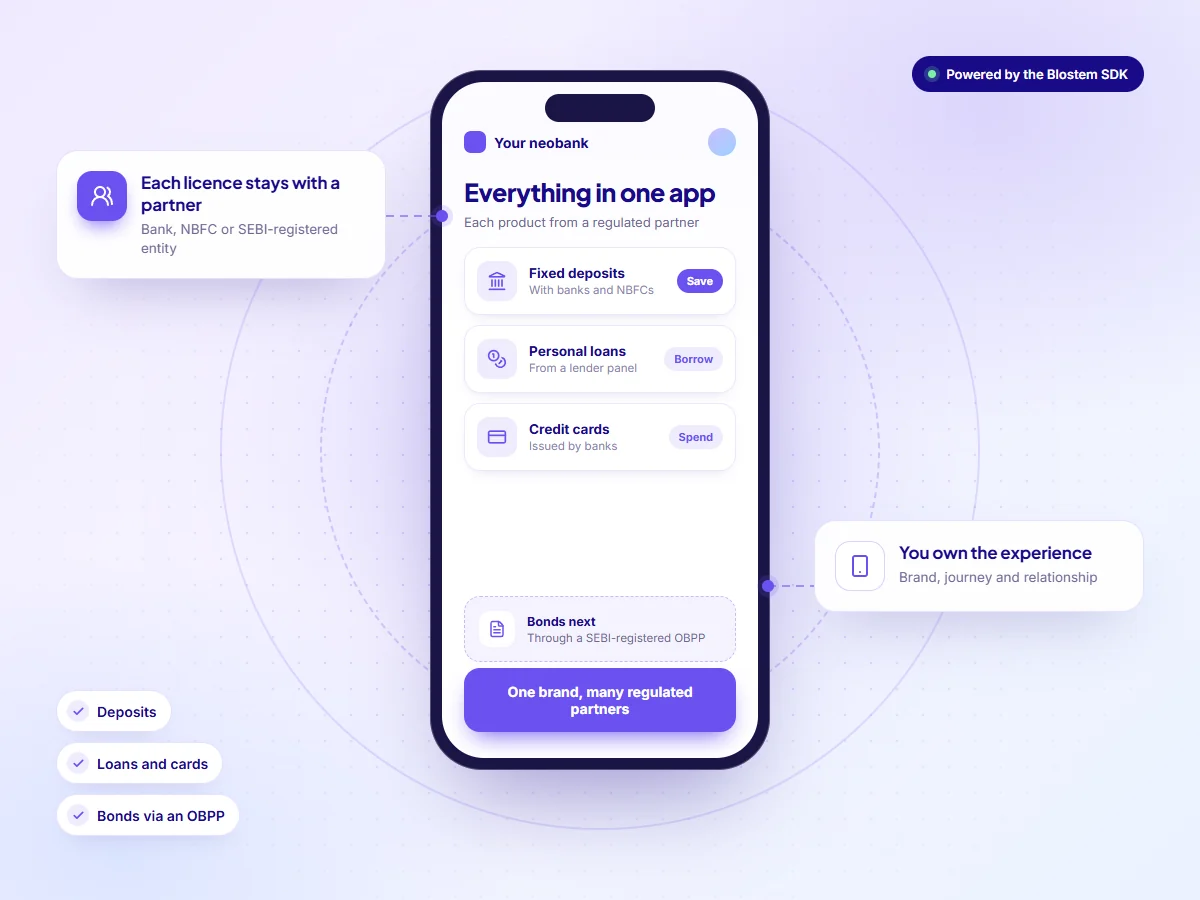
A neobank in India can launch fixed and recurring deposits, personal loans, loans against mutual funds, credit cards and bonds without its own licence, by partnering with regulated banks, NBFCs and SEBI-registered entities through a plug-and-play embedded finance and banking infrastructure company such as Blostem. The neobank owns the app and the customer experience, while a regulated partner holds the licence for each product.
- Deposits sit with a bank or a deposit-taking NBFC, in the customer’s name.
- Loans are made by a regulated bank or NBFC, and the neobank offers them through a lending service provider (LSP) layer.
- Credit cards are issued by a bank or an approved NBFC; the neobank handles discovery and distribution.
- Bonds are executed by a SEBI-registered OBPP and settle to the customer’s own demat account.
- Each product is easy to integrate with the Blostem SDK and can go live in weeks.
In this guide
Why a neobank works through regulated partners
In India, a neobank is an app, not a bank. Only banks, and NBFCs that hold a deposit-accepting registration, may accept public deposits. Loans come from regulated banks and NBFCs, cards from banks and approved NBFCs, and bonds through SEBI-registered intermediaries.
- The regulated partner holds the licence, the customer’s money and every approval decision.
- The neobank owns the brand, the customer relationship and where each product appears.
- The infrastructure provider supplies the SDK, KYC flows and journeys that connect the two.
What a neobank can launch, product by product
| Product | Regulated partner | Infrastructure route | Time to launch |
|---|---|---|---|
| Fixed deposits | Banks, small finance banks and NBFCs | FD SDK: one integration to 10+ issuers | Weeks |
| Recurring deposits | Banks and NBFCs | RD SDK with UPI Autopay | Weeks |
| Personal loans | A panel of regulated banks and NBFCs | Multi-lender personal loan SDK | Weeks |
| Loan against mutual funds | A regulated NBFC | LAMF SDK with digital lien marking | Weeks |
| Credit cards | Partner issuing banks | Card marketplace SDK, including FD-backed cards | Weeks |
| Bonds | A SEBI-registered OBPP | Bond SDK, settled to the customer’s own demat | Weeks |
Deposits: fixed and recurring deposits
The neobank shows FDs and RDs from partner issuers, and the customer pays the bank or NBFC directly. The issuer runs KYC, books the deposit in the customer’s name and holds it. A deposit-taking NBFC must be registered with the banking regulator to accept public deposits.
Bank deposits are covered by DICGC deposit insurance up to ₹5 lakh per depositor per bank, including interest. NBFC deposits are not, so label the two clearly. RDs start from ₹500 a month with Blostem, collected through UPI Autopay.
Loans: personal loans and loan against mutual funds
A neobank offers loans through a lending service provider (LSP) that works for each lender under a contract, such as Blostem’s LSP layer. Under the digital lending rules for banks and for NBFCs, the lender disburses straight into the borrower’s bank account, repayments go straight to the lender, and any fee due to the LSP is paid by the lender, not the borrower.
Where an LSP works with several lenders, it must show all matching offers in one digital view and name the lenders that did not match. For loans against mutual funds, a regulated NBFC lends against units pledged through a digital lien, so customers borrow without selling.
Credit cards
Banks issue credit cards under the card rules for banks. An NBFC needs the regulator’s prior approval to run a card business. A neobank can offer card discovery and eligibility checks, or a co-branded card, where the partner’s role is limited to marketing and distribution and it cannot access card transaction data.
For new-to-credit users, an FD-backed secured card lets the customer book an FD and get a card against it, subject to the issuer’s KYC and approval.
Investments: bonds
Bonds are offered through a SEBI-registered Online Bond Platform Provider (OBPP). The OBPP executes each order on NSE or BSE, and the bonds settle to the customer’s own demat account. The neobank shows the catalogue and runs the journey.
Three ways to launch regulated products
| Route | Time to launch | Cost and effort | Coverage | Who holds the licence |
|---|---|---|---|---|
| Build in-house with each partner | Months per partner, per product | High: separate integration, KYC, reconciliation and compliance for each | One partner per build | Each bank, NBFC or OBPP |
| Direct tie-up with one partner | Weeks to months | Medium: one partner’s journey, often in its brand | One product, one partner | That partner |
| Infrastructure providerRecommended | Weeks per product | Low: SDK, white-label journeys and servicing included | Six product types with Blostem, with 10+ FD issuers | Each regulated partner |
Six steps to launch your first regulated product
This is the path most neobanks follow with an infrastructure provider.
- Pick your first productStart with the product that fits your users today: deposits for savers, cards or loans for users who already borrow.
- Choose the regulated partnersFor each product, choose the banks, NBFCs or OBPP that will hold the licence, and confirm each one’s registration.
- Sign the agreementsAgree roles, data sharing, grievance handling and how commissions or fees are paid, product by product.
- Integrate the SDK in sandboxAdd the SDK to your app and run each journey against sandbox partners before production. Read the SDK getting started guide.
- Brand the journey and show the partnerMake every screen look like your app, while naming the regulated partner and showing its terms and disclosures. See the SDK theming docs.
- Launch one product, then add the nextGo live with one product, watch usage and complaints, then add the next product in the same app.
Which product earns first
Deposits are often the simplest first product: no credit risk for the neobank, a product users trust, and a distribution commission from the issuer on each booking. Credit products earn more per customer but need more care with disclosures, consent and collections, which the lender owns.
Monthly revenue = active users × % who take up the product × average ticket × your share
Run the formula per product with your own numbers, and ask your provider for the commercials on each one.
What to check in a provider
- Regulated partners: Is every issuer, lender and OBPP regulated, and can you see each registration?
- Money flow: Does customer money move only between the customer and the regulated partner?
- Product range: Which products are live today, and with how many partners each?
- Consent built in: Are consent, disclosures and Key Fact Statements part of each journey?
- White-label: Can every screen carry your brand while naming the regulated partner?
- Security evidence: Can they show ISO 27001 certification and independent security audits?
- Grievances: Who handles complaints for each product, and how are they tracked?
- Time to launch: Can they take you live in weeks, with a sandbox to test first?
Where Blostem fits
Blostem is a plug-and-play embedded finance and banking infrastructure company in India. It offers six products a neobank can embed: Fixed Deposits from 10+ banks and NBFCs on one integration, Recurring Deposits, Personal Loans, Loan Against Mutual Funds, Credit Cards including the FD-backed secured card, and Bonds.
Each product is easy to integrate with the Blostem SDK, white-label, and typically live in weeks. Blostem does not take deposits, lend, issue cards or hold customer money. See why fintechs choose Blostem.
Launch regulated products in your neobank
Get sandbox access to the Blostem SDK, or see the live demo with your team.
Neobank products without a licence: FAQs
Frequently Asked Questions